martes, 9 de diciembre de 2008

A comic sample


Spiderman vs Ronaldinho from Leliadoura on Comiqs

Answers

Dende este enlace podedes consultar as respostas a proba modelo que vos entreguei hoxe pola mañán

lunes, 8 de diciembre de 2008

RibEIra #2....


O CONCELLO DE RIBEIRA

RIBEIRA: City council: Santa Uxía of Ribeira (26943 inhabitants)Capital; Ribeira, with 13420 inhabitants.

- Location: South of the province of A Coruna, north of the Arousa estuary and the southern coast of A Morte. Peninsula, bathed by the Atlantic Ocean.

Among other wonders with the Natural Park of Dunes Corrubedo, the archipelago of Sálvora, Mount and the City of San Roque and numerous beaches, two blue flag, as well as with Yacht Club. It is the largest coastal port in Europe and is the capital of
Egypt.

- Monuments: Wharf Phoenicians, later restored by the Catalans to download salting from a factory built in the Isle of Sálvora by the Castilian Hijosa of Jerome in 1770, at his side, the remains of an old warehouse salazonero that preserves some of the stones used for the pressing of fish. Castro de Baixo Porto (Roman, of Celtic origin) at the height of the Lagoa Vixán (which belongs to the people of Carreira) and located on the beach of the same name. Mirador de Couso beautiful park with suburban composed of stone benches and tables as well as several sources and grill, wide parking area, since the currency was all the Arousa estuary and the archipelago of Sálvora, Vionta and Noro. Mariñeiro do monument, carved in stone and situated in the port of Aguiño. Cruceiro do Porto e da Cruceiro Igrexa (the first of the XVIII century and the second from S. XX). Hórreo grain and dovecote, located in the courtyard of the Church, beautiful modern Temple (1965) to styles where seamen interiors are kept even the bones of a whale. Cruz (Stone sacrifices Christianized whose origins lie in S. III of our era.

Ribeira:

Riveira is the capital region to do Barbanza and capabilities punteiras one of the Rias Baixas and Galicia. The people amount to more than 27,000 Persian limes case the 14,000 live in Santa Uxía, the main town center and parish. A town is from some years irmanada co Tenerife municipality of Adeje and with the locality U.S. Newark, the state of New Jersey, because of major riveirenses established community of neste site.

MORE INFORMATION:

Dunas de corrubedo

It’s a protected space that doesn’t reach the 1,000-hectare site, but with a great diversity of habitats and species of animals and plants of great interest. In addition to the Natural Park was described as Wetlands of International Importance (Ramsar Humidal), is included in the proposal Galician Natura 2000 and was declared Area Space Importance for Birds. It has the largest mobile dune in northwestern Peninsular with more than 1 km in length, 200-300 meters wide and over 20 m in height.

Playa del vilar

CHARACTERISTICS:

Virgin beach environment integrated into the complex dune Corrubedo and Lakes of Carregal and Vixán. By rectilinear base with white sand and protected. In moderate swell. It has surveillance service during the summer (Civil Protection and Red Cross). Daily cleaning. Local police patrol the beach during the summer. Marina closest: Ribeira.

Blue flag .

Muelle fenicio de aguiño

Castro de Baixo Porto (Roman, of Celtic origin) at the height of the Lagoa Vixán (which belongs to the people of Carreira) and located on the beach of the same name. Mirador de Couso beautiful park with suburban composed of stone benches and tables as well as several sources and grill, wide parking area, since the currency was all the Arousa estuary and the archipelago of Sálvora, Vionta and Noro. Mariñeiro do monument, carved in stone and situated in the port of Aguiño. Cruceiro do Porto e da Cruceiro Igrexa (the first of the XVIII century and the second from S. XX). Hórreo grain and dovecote, located in the courtyard of the Church, beautiful modern Temple (1965) to styles where seamen interiors are kept even the bones of a whale. Cruz (Stone sacrifices Christianized whose origins lie in S. III of our era.

Dolmen de axeitos

INFO:

The Dolmen Axeitos, is located in the parish of Axeitos at Oleiros. The funerary monument of the era megalithic Antas is one of the most representative of the Galician prehistory. Has approximately 4000 years old.

Mirador de San Roque

INFO:

Since we can appreciate the history of arousa.This park we play vestijios of wreckage left by our ancestors. Such as hill forts, taxed the cave, and the Roman remains ...

Mirador de san Alberte

INFO:

Located on the mountain that bears the same name, has an approximate height of 190 m and are found in the chapel of St. Albert. It is a natural view, readily accessible by road from which we can see a broad and beautiful landscape, with history at your feet

Faro de corrubedo

INFO:

The Lighthouse Currubedo this at the tip of the cape located in a rocky environment. Its construction is simple but we must highlight the views of the people who have Corrubedo and the Arousa estuary.

Isla de Sálvora

INFO:

Sálvora Island is an island in the Atlantic Ocean, which is at the mouth of the estuary of Arousa, Galicia, Spain. Separated from land by a distance of about 3 km in the North. It occupies an area of about 190 hectares, and has a maximum elevation of 71 meters (As Gralleiras). Almost the entire perimeter of the island is rocky area, with the exception of three beaches of fine white sand. Since 2002, is integrated into the National Park of the Atlantic Islands of Galicia.

At present, the island of Sálvora is part of the Parish of Carmen de Nosa Madam do Aguiño, founded in 1959. Previously the island depended on the parish of St. Paio Carreira, which was for many centuries, the most populous and wealthy parish of the district, as well as the oldest.

In March 2007 the island was acquired by Caixa Galicia by 8.5 million euros and by the end of that year the Ministry of Environment has exercised its right of first buying Sálvora, Vionta and Noro by the same amount. The Board of Galicia, which is listed as owner of the site since July 1,
2008, in conjunction with the Ministry of Environment has begun work to rehabilitate the enclave.

jueves, 4 de diciembre de 2008

RibeiRa Its The best Cityy

Ribiera is Galicia's main fishing port and is economically important, not just to Galicia but, to the whole of Spain. Sited in the lower bays, this ancient town lands huge quantities of fish and sea food and also acts as the sales room for many of the regions smaller port towns.

General information about Ribeira

Ribeira is a genuine working fishing town with a large port capable of taking deep sea fishing vessels. The town, whilst not exactly a picturesque piece of Galician urbanisation, is popular with holiday makers and gives a true view of Galicia's ancestory and seafaring history. The town is always busy and is the best spot in Galicia to get freshly caught and cooked seafood. Sardines are a local speciality.

What to see in the town of Ribeira

Tip 1. Ribeira's main appeal is that of a working fishing port. There is a large key and it has a busy market with constant deliveries of fish. The town is certainly not from a picture postcard, but it still gets a large number of holiday visitors.

Tip 2. The small towns and villages of the greater Ribeira area are worth a look. There are several of them and they are all located on the coast. This stretch of the rias baixas also has some of Galicia's best beaches, many hidden away in small coves and bays.

Tip 3. For anyone who likes fish, a plate of the local favourite, sardines, at one of the harbour side bars is a must. Ribeira has a big sardine festival in the summer and is reputed to serve the best (and certainly the most recently caught) sardines in Galicia.

Tip 4. Located only a few kilometres from Ribeira and also on the sea front is a large sand dune with a visitor centre and large beach. Called the Complexo Dunar de Corrubedo e Lagoas de Carregal e Vixan, this dune is a natural phenomenon and attracts a lot of visitors, especially if the weather is good.

Tip 5. Ribeira has a number of festivals and nearly all are connected with fishing or the sea. If you are fortunate enough to see one, you will gain an insight into the history and traditions of the town.


Where is Ribeira and how do you reach it

The closest major city to Ribeira is probably Santiago de Compostela. Reaching Ribeira from Santiago by the scenic route can take a couple of hours, but the views are good and much of the route is coastal. Taking the main highways is much quicker.

Ribeira is one of a large number of towns that holiday visitors to Galicia are likely to call in at and explore. Ribeira is not the best place from which to base a holiday, but it is an ideal stop to build into a day out driving down the sea front. Parking can be difficult in the old town.


Ribeira's fiestas and our verdict

There is no shortage of festivals in the Ribeira vicinity, it is a big town and the main festival season commences in late Spring. Below is a summary of Ribeira's most significant and well known fiesta events.

  • The fiesta of the "Virgin de A Guia" takes place in May and is held in the district of "Pelayo de Carreira".
  • July sees the fiesta of "Dorna"
  • In August there is a big flower festival which features floral carpets and is centered near "Santa Uxia de Ribeira". This festival is apparently very spectacular and attracts many visitors from the vicinity.
  • In September Ribeira has the feast of "Santa Uxia" and the festival season ends for another year.

What else is close to Ribeira

If you want a really massive beach, then near by Corrubedo bay with its mile long sand dune, life guard posts and visitors center should be the ticket.
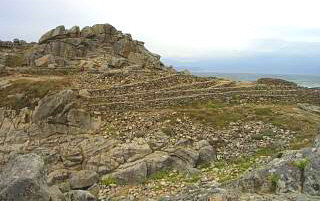
Castro de Barona

If you are looking for artefacts or ancient ruins, then a short journey will take you to the "Oleiros" where you can look at a collection of overlapping stones that date back to the time of pre-history - or so the story goes.

A further short drive down the main highway (C550), will lead you to "Porto do Son", where you can see the ancient Celtic ruins of Castro de Barona.
Above right, the ruins at the ancient Celtic settlement of "Castro de Barona", a short drive from Ribeira.

Our verdict on Ribeira

To be honest Ribeira is not a major haven for tourists, it is a real fishing port and its attraction to the vacationer interested in Galicia should be in seeing just that. If you want to see "living history", then visit Ribeira, if you do not, then give it a miss.
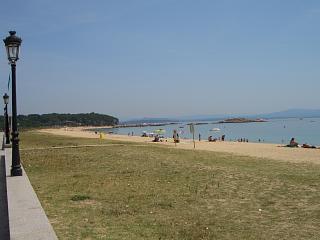
Ribeira's main beach

We personally liked Ribeira and for me it evoked memories of the former fishing port of Hull in the UK which I had visited as a child.

The other thing that really impressed us was the multitude of attractive and extremely well serviced beaches that are scattered around the localities close to Ribeira.

So in summary, if you want a glimpse of Galicia's sea fairing and economic heritage followed by a spell on an attractive beach, albeit with pretty cool sea, Ribeira won't disappoint.


The port town of Ribeira is positioned at the very end of the Barbanza peninsula on the northern lip of the ria de Arousa (bay of Arousa) and is regarded as one of Galicia's oldest and most important seaport towns.

Approaching Ribeira from any direction takes you down from the hills that surround the town to a bay which is almost crescent shaped and features a large port. If you enter Ribeira by car there is plenty of parking available to the right of, and beyond, its large commercial dock. There is also a tourist office quite close to the dock from which you can get a town map and other visitor information leaflets.

Ribeira has much to offer the visitor. You can soak up the atmosphere of a traditional Galician fishing town and visit one of the most active fish markets in the whole of Spain. Even in the late morning crates of fish and buckets of crustaceans still arrive from the latest catch.

Ribeira - Gastronomy:Ribeira, La Coruna, Galicia, northern green Spain

If you like sardines, then this is the place to eat them. Ribeira has a reputation for sardines and a festival that celebrates them. Even as you walk along the streets that line the harbour you are constantly aware of the smell of cooking sardines as it wafts around in the air, as there is no shortage of small bars constantly grilling them.

Ribeira - Sight-seeing:

The greater part of Ribeira towns sea front is dominated by its large port, but as you step back in to the town itself, you will find a busy and bustling hive of activity with plenty of shops and the occasional interesting building. Ribeira does have some Galician mansion houses and some old churches, but it is more the atmosphere of the place that will determine whether you like it or not.

One other thing that is worth doing at Ribeira is going to the top of mount Castro. It is more a hill than a mountain, but affords spectacular views in every direction of the bay's mouth and Galicia's Atlantic coastline.

Ribadeo is an attractive town with a castle and many colonial style buildings. It is also an early stop on one of the Caminos, or pilgrim routes. It is over 100km from the city of Lugo.

Ribeira - Our holiday accommodation and service:

Travel with secretdestinations.com holidays and enjoy delightful, privileged, sophisticated Galician holiday destinations in La Coruna province, including Ribeira. From privately owned houses, charming cottages, villas and apartments to villas with pools and hotels; all in beautiful coastal and rural locations, hand-picked for an authentic taste of unspoiled Galicia and secret Northern Green Spain.

So, if you're looking for an activity holiday walking, cycling and trekking or climbing in Northern Green Spain's mountains and countryside; exploring La Coruna's fascinating Galician villages, rural towns and historic cities such as Santiago de Compostela; following the historic pilgrims' routes; enjoy bird watching, nature, fancy a spot of surfing, swimming, sunbathing or relaxing on great beaches; sampling fabulous Galician seafood or you just want to simply escape the tourism masses with a privately owned apartment, cottage or villa with a pool, call our holiday team today. We can also assist you with flights to La Coruna and Galicia, ferry travel and holiday car hire.


DaviD,Aida,Laura,Maria,Maka,Marta 2ºB

martes, 11 de noviembre de 2008

ANSWERS

And here you have the answers

PROBA 1º EXAME 1ª AVALIACIÓN

Here you can practise for tomorrow's exam

How to form present simple

A video on forming the present simple:


jueves, 6 de noviembre de 2008

HERE you'll find a powerpoint to study the Simple Present.

Dido's Exercices

HERE you'll find exercices on Dido's sond

jueves, 30 de octubre de 2008

Halloween

HALLOWEEN

Introduction:


Halloween
(or Hallowe’en) is an international holiday celebrated on October 31. Halloween activities include trick-or-treating, ghost tours, bonfires, costume parties, visiting haunted attractions, carving jack-o'-lanterns, reading scary stories, and watching horror movies. Irish immigrants carried versions of the tradition to North America in the nineteenth century. Other western countries embraced the holiday in the late twentieth century. Halloween is celebrated in several countries of the Western world, most commonly in the United States, Canada, Ireland, Puerto Rico, Japan, New Zealand, United Kingdom, and at times in parts of Australia. In Sweden the All Saints' official holiday takes place on the first Saturday of November.

History:

Halloween has its origins in the ancient Celtic festival known as Samhain from The festival of Samhain is a celebration of the end of the harvest season in Gaelic culture, and is sometimes regarded as the “Celtic New Year” Traditionally, the festival was a time used by the ancient pagans to take stock of supplies and slaughter livestock for winter stores. The ancient Gaels believed that on October 31, now known as Halloween, the boundary between the alive and the deceased dissolved, and the dead become dangerous for the living by causing problems such as sickness or damaged crops. The festivals would frequently involve bonfires, into which bones of slaughtered livestock were thrown. Costumes and masks were also worn at the festivals in an attempt to mimic the evil spirits or placate them

History of name:

The term Halloween is shortened from All Hallows' Even (both "even" and "eve" are abbreviations of "evening", but "Halloween" gets its "n" from "even") as it is the eve of "All Hallows' Day", which is now also known as All Saints' Day. It was a day of religious festivities in various northern European Pagan traditions, until Popes Gregory III and Gregory IV moved the old Christian feast of All Saints' Day from May 13 (which had itself been the date of a pagan holiday, the Feast of the Lemures) to November 1. In the ninth century, the Church measured the day as starting at sunset, in accordance with the Florentine calendar. Although All Saints' Day is now considered to occur one day after Halloween, the two holidays were, at that time, celebrated on the same day. Liturgically, the Church traditionally celebrated that day as the Vigil of All Saints, and, until 1970, a day of fasting as well. Like other vigils, it was celebrated on the previous day if it fell on a Sunday, although secular celebrations of the holiday remained on the 31st. The Vigil was suppressed in 1955, but was later restored in the post-Vatican II calendar.

Symbols:

The carved pumpkin, lit by a candle inside, is one of Halloween's most prominent symbols in America, and is commonly called a jack-o'-lantern. Originating in Europe, these lanterns were first carved from a turnip or rutabaga. Believing that the head was the most powerful part of the body containing the spirit and the knowledge, the Celts used the "head" of the vegetable to frighten off any superstitions. The name jack-o'-lantern can be traced back to the Irish legend of Stingy Jack, a greedy, gambling, hard-drinking old farmer. He tricked the devil into climbing a tree and trapped him by carving a cross into the tree trunk. In revenge, the devil placed a curse on Jack, condemning him to forever wander the earth at night with the only light he had: a candle inside of a hollowed turnip. The carving of pumpkins is associated with Halloween in North America, where pumpkins were readily available and much larger, making them easier to carve than turnips. Many families that celebrate Halloween carve a pumpkin into a frightening or comical face and place it on their home's doorstep after dark. In America the tradition of carving pumpkins is known to have preceded the Great Famine period of Irish immigration. The carved pumpkin was originally associated with harvest time in general in America and did not become specifically associated with Halloween until the mid-to-late 19th century.

The imagery surrounding Halloween is largely an amalgamation of the Halloween season itself, nearly a century of work from American filmmakers and graphic artists,and a rather commercialized take on the dark and mysterious. Halloween imagery tends to involve death, magic, or mythical monsters. Traditional characters include ghosts, ghouls, witches, owls, crows, vultures, pumpkin-men, black cats, spiders, goblins, zombies, mummies, skeletons, and demons.

Particularly in America, symbolism is inspired by classic horror films, which contain fictional figures like Frankenstein's monster and The Mummy. Elements of the autumn season, such as pumpkins and scarecrows, are also prevalent. Homes are often decorated with these types of symbols around Halloween.

Costumes:

Halloween costumes are traditionally those of monsters such as ghosts, skeletons, witches, and devils. Costumes are also based on themes other than traditional horror, such as those of characters from television shows, movies and other pop culture icons.

Costume sales:

BIGresearch conducted a survey for the National Retail Federation in the United States and found that 53.3% of consumers planned to buy a costume for Halloween 2005, spending $38.11 on average (up 10 dollars from the year before). They were also expected to spend $4.96 billion in 2006, up significantly from just $3.3 billion the previous year.

Games and other activities:

In this Halloween greeting card from 1904, divination is depicted: the young woman looking into a mirror in a darkened room hopes to catch a glimpse of the face of her future husband.

There are several games traditionally associated with Halloween parties. The most common is dunking or apple bobbing, in which apples float in a tub or a large basin of water; the participants must use their teeth to remove an apple from the basin. A variant of dunking involves kneeling on a chair, holding a fork between the teeth and trying to drop the fork into an apple. Another common game involves hanging up treacle or syrup-coated scones by strings; these must be eaten without using hands while they remain attached to the string, an activity which inevitably leads to a very sticky face.

Some games traditionally played at Halloween are forms of divination. In Puicíní (pronounced "poocheeny"), a game played in Ireland, a blindfolded person is seated in front of a table on which several saucers are placed. The saucers are shuffled and the seated person then chooses one by touch. The contents of the saucer determine the person's life during the following year. A saucer containing earth means someone known to the player will die during the next year, a saucer containing water foretells emigration, a ring foretells marriage, a set of Rosary beads indicates that the person will take Holy Orders (becoming a nun or a priest). A coin means new wealth, a bean means poverty, and so on. In 19th century Ireland, young women placed slugs in saucers sprinkled with flour. A traditional Irish and Scottish form of divining one's future spouse is to carve an apple in one long strip, then toss the peel over one's shoulder. The peel is believed to land in the shape of the first letter of the future spouse's name. This custom has survived among Irish and Scottish immigrants in the rural United States.

Unmarried women were frequently told that if they sat in a darkened room and gazed into a mirror on Halloween night, the face of their future husband would appear in the mirror. However, if they were destined to die before marriage, a skull would appear. The custom was widespread enough to be commemorated on greeting cards from the late nineteenth and early twentieth centuries. The mirror gaze was one of many forms of love divination around Halloween and other ancient holy days.

The telling of ghost stories and viewing of horror films are common fixtures of Halloween parties. Episodes of TV series and specials with Halloween themes (with the specials usually aimed at children) are commonly aired on or before the holiday while new horror films, like the popular Saw films, are often released theatrically before the holiday to take advantage of the atmosphere.

Haunted Attractions:

Haunted attractions are entertainment venues designed to thrill and scare patrons, and typically are seasonal Halloween businesses. They include haunted houses, corn mazes, and hayrides that are staffed by actors in horrifying costumes placed to startle and terrify customers.

Foods:

Because the holiday comes in the wake of the annual apple harvest, candy apples (also known as toffee or taffy apples) are a common Halloween treat made by rolling whole apples in a sticky sugar syrup, and sometimes rolling them in nuts. At one time, candy apples were commonly given to children, but the practice rapidly waned in the wake of widespread rumors that some individuals were embedding items like pins and razor blades in the apples.While there is evidence of such incidents, they are quite rare and have never resulted in serious injury. Nonetheless, many parents assumed that such heinous practices were rampant; at the peak of the hysteria, some hospitals offered free x-rays of children's Halloween hauls in order to find evidence of tampering. Virtually all of the few known candy poisoning incidents involved parents who poisoned their own children's candy, while there have been occasional reports of children putting needles in their own (and other children's) candy in a mere bid for attention.

One custom which persists in modern-day Ireland is the baking (or more often nowadays the purchase) of a barmbrack (Irish "báirín breac"), which is a light fruit cake into which a plain ring, a coin and other charms are placed before baking. It is said that those who get a ring will find their true love in the ensuing year. See also king cake.

jueves, 23 de octubre de 2008

Webquest

Here you can find a webquest to organize a trip to london.

viernes, 17 de octubre de 2008

jueves, 16 de octubre de 2008

jueves, 2 de octubre de 2008

Exercise #1

Here you have exercises to practice present simple verbs

WELCOME

Welcome, this is 2ºB's english blog. Here you can see all kind of english grammer, songs and videos. I hope you enjoy it!

WELCOME

Here you can find some exercises to practice simple present